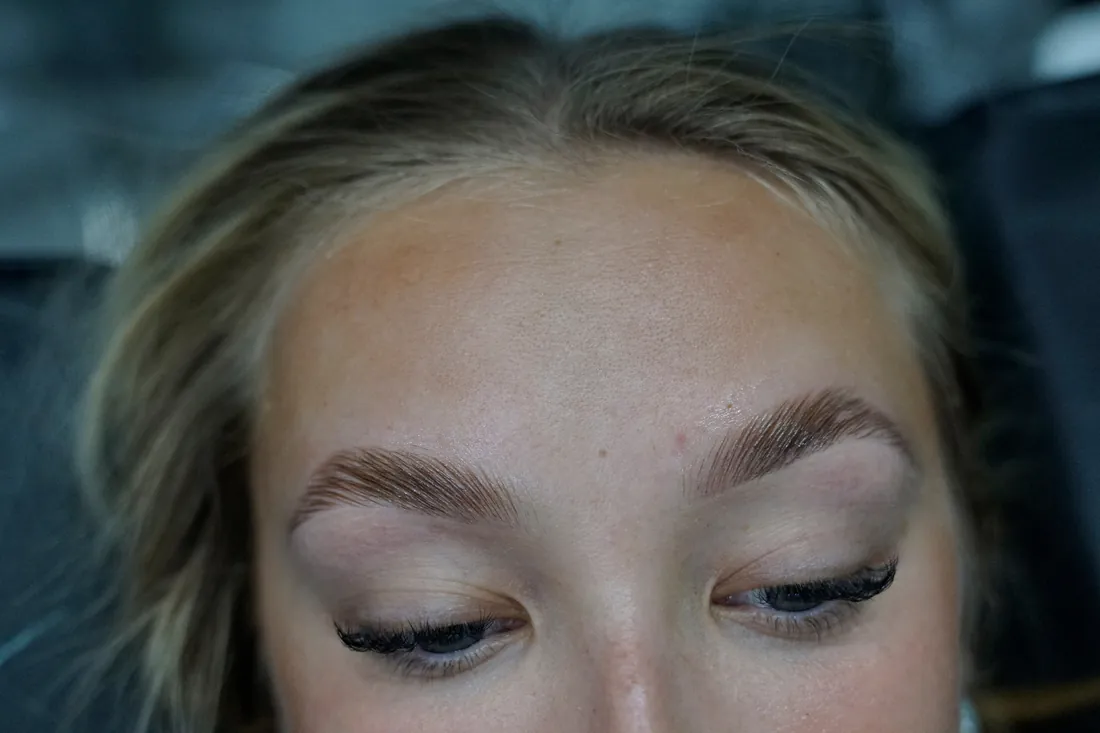
What Brow Lamination Actually Is
Brow lamination is a chemical styling treatment—often called a "brow perm"—that temporarily reshapes the brow hairs you already have. It does not add hair, color the skin, or create new density. It relaxes the internal bonds in each hair so the hair can be brushed into a new direction, then locks that direction in place.
The service is done in three steps:
Lifting solution (usually a thioglycolate-based cream) softens the disulfide bonds in the hair, making it pliable.
Neutralizing/setting solution re-forms those bonds so the hairs hold their new upward, brushed-out shape.
Nourishing/conditioning step (keratin, oils, or a serum) to rehydrate the hair after processing.
Total processing time is short—typically 10 to 15 minutes of active product time, with the full appointment running about 45 minutes to an hour when shaping and tinting are included. Results generally last four to six weeks, until new growth replaces the treated hair.
The Most Important Thing to Know: You Need Brow Hair
This is the part that gets glossed over in a lot of marketing, and we would rather be honest with you.
Lamination redirects existing hair. It cannot create hair that isn't there.
If you have sparse patches, a thin tail, or a gap from over-plucking, lamination can only help to the extent that there are nearby hairs long enough to be brushed across the gap. Brows with decent length and reasonable density will look dramatically fuller. Brows that are genuinely sparse, short, or patchy will look neater—but the gaps will still be visible.
For truly sparse brows, a pigment-based service like nano shading or microblading is the honest answer, and lamination can be added later once there is more to work with.
Who Gets the Best Results
You are an excellent candidate if you have:
Unruly, coarse, or thick brows that never sit where you want them. This is the single best use case—lamination tames texture that brow gel can't hold.
Downward-growing hairs, especially at the inner corner or along the top line, that hide your natural arch.
Long brow hairs with visible gaps underneath. Lifting the hair upward lets it cover bare skin, creating real visual fullness.
Curly or wavy brow hair that crosses over itself or sticks out in different directions.
Asymmetrical brows where one side sits lower or grows differently than the other. Directional setting can bring them closer to matching.
Anyone tired of daily brow gel, soap brows, or pomade. The convenience factor is real—most clients wake up with brows already done for four to six weeks.
Add a tint and the effect goes further: tinting darkens the fine, pale vellus hairs around the brow that you didn't even know were there, which reads as extra density. Lamination plus tint together is where most people see the "wow" difference.
Who Should Skip It (Or Wait)
We would rather turn a service away than damage your brows. Lamination is not the right call if you have:
Very sparse, short, or heavily over-plucked brows. There isn't enough hair to redirect. You will be disappointed, and the chemical processing gives you nothing in return.
Fine, fragile, or previously damaged brow hair. Over-processing is the number one risk of this service, and fine hair reaches that point fast. The result is frizzy, dry, brittle hairs that can break off at the skin.
Recently laminated brows. Back-to-back services on the same hairs is the fastest route to damage. Wait a minimum of six to eight weeks between appointments—longer if your brows feel dry.
Active skin conditions in the brow area—eczema, psoriasis, dermatitis, open cuts, sunburn, cold sores, or an active breakout on the brow bone.
Recent facial treatments. Wait at least two weeks after chemical peels, laser, microdermabrasion, waxing that caused irritation, or a fresh brow tattoo/microblading (wait until fully healed, typically 4–6 weeks).
Known sensitivity to thioglycolates, perm solutions, or hair dye. If a perm or a box dye has ever burned or blistered you, tell your artist before booking.
Certain medications and conditions. Accutane/isotretinoin (within six months), active chemotherapy, or a doctor's instruction to avoid chemical treatments on the skin.
Alopecia areata, trichotillomania, or any condition involving active brow hair loss, unless your physician has cleared it.
Pregnancy and nursing: there is no evidence that brow lamination is harmful, but no formal safety studies exist either. Many artists—including us—prefer to reschedule or ask for a note from your provider. Hormonal shifts can also change how hair processes, so results can be unpredictable.
Under 18: we require a parent or guardian's consent, and we often recommend waiting, since brow hair is still developing.
Patch Testing Is Not Optional
Allergic contact dermatitis from lifting solution or tint is uncommon but real, and it is much easier to prevent than to treat. We ask first-time clients—and anyone with a history of sensitivity—to have a patch test at least 24 to 48 hours before the appointment. It takes two minutes.
Signs of a reaction to report immediately: itching, burning, swelling, redness that doesn't fade, or small blisters.
The Real Benefits, Honestly Stated
Fuller-looking brows without pigment. No needles, no tattoo, no healing period.
Symmetry and shape control that brow gel simply cannot hold all day.
Time saved every morning. Five minutes of brow routine, gone.
Fully reversible. Unlike a tattooed service, lamination grows out. If you don't love it, it's temporary.
Painless and quick. No needles, no downtime, back to your day immediately.
Pairs beautifully with other services. Lamination plus tint plus a precise wax or tweeze shape is the combination most clients book.
The Honest Risks
Over-processing is the main one. Too much time in the lifting solution, or services scheduled too close together, leaves hair dry, frizzy, and brittle. This is why timing and an experienced artist matter more than price.
Irritation or contact dermatitis in sensitive skin.
Eye irritation if product migrates. It should never happen with correct application and eye protection.
Results that fade unevenly as new hair grows in at its natural angle.
None of these are reasons to avoid the service—they are reasons to have it done properly, on the right brows, at the right interval.
Aftercare: The First 24 to 48 Hours Matter Most
The bonds are still settling after your appointment. For the first 24 hours (48 is safer):
Keep brows completely dry. No water, no steam, no sweat, no showers directly on the face.
No makeup, cleansers, serums, or oils on or around the brows.
No swimming, saunas, steam rooms, or hot yoga.
Don't rub, touch, or sleep face-down on your brows.
After the first 48 hours:
Brush your brows daily with a clean spoolie to keep the shape crisp.
Apply a nourishing oil or brow serum (castor oil or a conditioning brow serum) a few times a week. Laminated hair is thirstier than untreated hair, and conditioning is what prevents the frizzy look people complain about.
Avoid oil-based makeup removers directly on the brows if you also wear lash extensions, and be gentle regardless.
Use SPF. Sun exposure fades tint and dries the hair.
How Often You Can Rebook
Every six to eight weeks is the safe rhythm for most people, and many clients stretch it further. If your brows feel dry, straw-like, or look frizzy, that is your cue to skip a round and condition instead. A good artist will tell you to wait—we would rather protect your hair than sell you a service.
Tints fade faster than the lift, so a tint-only refresh between laminations is a good middle option.
Not Sure If You're a Candidate?
The fastest answer is a short consultation. We will look at your brow density, hair length, growth direction, and skin condition, and tell you honestly whether lamination will give you the result you're picturing—or whether shaping, tinting, or nano shading would serve you better.
Book a brow consultation with Masha Lash and we will build the right plan for your brows.